What Makes Ascendica Different?
Many electrolyte mixes rely primarily on isolated mineral salts—forms like magnesium oxide or calcium carbonate refined for water solubility, shelf life and cost efficiency. While absorption rates can vary by form, these isolated salts don’t contain the broader mineral matrix found in whole-food mineral sources.
At higher concentrations, some isolated mineral forms are not always well-tolerated¹, which leads many electrolyte products to take a more conservative approach to their mineral dosages.
At Ascendica, mineral diversity, bioavailability, and intentional formulation are central considerations in how our products are created, to support a full-spectrum electrolyte profile you can feel confident about.
Curious about the intention behind our blend? Let’s look at the specific mineral ratios and high-integrity ingredients that define our approach to full-spectrum hydration.
"Aren't We Often Told to Limit Salt?"
Sodium is a highly regulated electrolyte that moves in and out of the body continuously via the kidneys, sweat, and urine, playing a central role in fluid balance, nerve signaling, muscular function and cellular hydration. Many are advised to moderate sodium intake due to its role in fluid balance and cardiovascular health, particularly for individuals with certain medical conditions. At the same time, sodium retention is influenced by multiple interacting factors beyond intake alone. physiological elements play a pivotal role in the management of sodium, including:
Because of these common factors, sodium retention should be considered the result of multiple interacting pathways rather than salt intake alone. Sodium requirements can differ substantially depending on factors such as sweat loss, activity level, climate, and overall diet composition.
Research on sodium physiology has evolved considerably since the early population-wide guidelines were established.
Multiple studies show that in situations where significant sweat loss occurs (e.g., prolonged exercise or heat exposure), sodium losses can exceed 1,000 mg per hour, and in some highly active individuals, sodium losses may reach multiple grams per hour, though losses can vary widely²,³,⁴. Many modern electrolyte products provide sodium levels that align with general dietary recommendations rather than the higher sodium losses that may be experienced in different conditions.
1,000mg Sodium Per Serving in Ascendica™ Vital Hydration
Common habits like drinking caffeine, working in warm environments, or engaging in movement across the day can also elevate sodium loss. Even at rest, the body continuously regulates electrolyte balance, with ongoing sodium losses occurring primarily through urine and, to a lesser extent, sweat. As a result, baseline losses will occur regardless of salt intake.
We use 1,000 mg of sodium per serving to better match real-world sweat losses that may be experienced.
insulin
aldosterone
stress
dehydration
sedentary behavior
sleep restriction
estrogen fluctuations
Baja Gold™ Ancient Sea Salt
Baja Gold™ Ancient Sea Salt is a mineral-rich sea salt harvested from clean, low-pollution waters in the Sea of Cortez, recognized for it's sustainable harvesting practices and diverse mineral profile. It is produced through natural solar dehydration rather than industrial refining, leaving its native mineral profile of trace minerals intact.
This distinguishes Baja Gold from commercially refined sodium chloride, which is stripped to almost pure NaCl and typically processed with synthetic anti-caking agents. Baja Gold’s minimal processing preserves naturally occurring magnesium, potassium, calcium, and other trace electrolytes that contribute to flavor complexity and additional mineral diversity.
Why We Use Aquamin®
Harvested from red marine algae off the coast of Iceland, Aquamin® provides a full-spectrum of naturally occurring minerals — including calcium, magnesium, and other trace elements.
Aquamin Mg Soluble (Magnesium-rich) and Aquamin S (Calcium-rich) are not just pure, single-mineral compounds. They are mineral complexes that contain over 70+ trace minerals naturally accumulated by the red marine algae/seawater. These trace minerals are often co-factors that can support the utilization of the main mineral. In nature, minerals found in whole foods exist as part of a mineral matrix, not as single isolated compounds. Aquamin® reflects this natural complexity through its multi-mineral profile.
Aquamin® minerals are derived from calcified red marine algae and retain a naturally porous, honeycomb-like structure with high surface area. In a 90-day human study, Aquamin® demonstrated measurable biological effects in colonic tissue compared to calcium alone⁵.
The Honeycomb Structure
Magnesium Bioavailability & Utilization
For magnesium, Research on Aquamin® Mg indicates favorable solubility and bioaccessibility under simulated gastric and intestinal conditions. Compared with commonly used forms such as magnesium oxide and bisglycinate, Aquamin® Mg demonstrated higher solubility during digestion, meaning more magnesium remained in a dissolved form during simulated digestion. In human tolerability research, marine-derived magnesium was associated with improved gastrointestinal tolerability compared with commonly used forms
Gut Microbiome Support
In addition to mineral delivery, Aquamin® complexes have also been studied for their interaction with the gut environment. Research suggests that multi-mineral matrices from marine algae may support microbial diversity, highlighting a potential distinction between whole-matrix mineral sources and single isolated mineral salts⁸.
The Calcium Conversation
Calcium is a key electrolyte that supports muscle contraction, nerve signaling, and heart function. It interacts with sodium, potassium, and magnesium to maintain cellular stability and overall electrolyte balance. Even though sweat losses are smaller than sodium or potassium, including calcium in electrolyte products helps ensure comprehensive support during periods of heavy sweating and intense physical activity.
Many commercially available electrolyte products provide only small amounts of calcium - or avoid calcium altogether - But A 2024 study found that a substantial portion of U.S. adults consistently fail to meet the Estimated Average Requirement (EAR) for calcium, even when including calcium from supplements⁹.
Much of this calcium avoidance in common electrolyte products stem from concerns of calcium supplementation increasing risk of cardiovascular disease¹⁰. For this reason, Ascendica uses red algae-derived Aquamin® S, a naturally occurring, food-derived calcium source within its native mineral matrix rather than as a purified calcium compound¹¹. This matrix allows the calcium to exhibit different solubility and bioaccessibility characteristics when compared with isolated calcium salts, reflecting how minerals are present in nutrient-dense foods⁶,¹². This distinction is why mineral form and matrix are central considerations in how we approach our electrolyte formulations.
Organic Coconut Water Powder
Organic coconut water powder provides the potassium and naturally occurring minerals derived from real coconut water in a clean, concentrated form, contributing to electrolyte density without the unnecessary fillers.
In addition to key electrolytes, coconut water powder contains naturally occurring amino acids and phytonutrients that contribute to it's whole-food mineral matrix.
Its naturally mild sweetness help our blends achieve a smooth, refreshing taste without the need for added sugars.
ZERO Synthetic Anti-Caking Agents
Many commercial mineral salts utilize synthetic anti-caking agents (such as silicas, silicates, or talc) to simplify manufacturing and improve shelf flow. However, peer-reviewed research shows that some of these materials can alter powder surface behavior and moisture dynamics, mechanisms linked to accelerated degradation of certain nutrients in moisture-sensitive formulations¹³,¹⁴.
These statements have not been evaluated by the Food and Drug Administration. This product is not intended to diagnose, treat, cure, or prevent any disease.
Consult your physician before use if you are pregnant, nursing, or have a medical condition, specifically those requiring a sodium-restricted diet.
Setting The Gold Standard In Electrolyte Synergy
Made With :
Organic Monk Fruit Powder
Zero Artificial Flavors, Sweeteners, Or Preservatives
Organic Freeze-Dried Lemon Powder And Organic Vanilla Bean Powder
100% Non-GMO Ingredients
Organic Coconut Water Powder
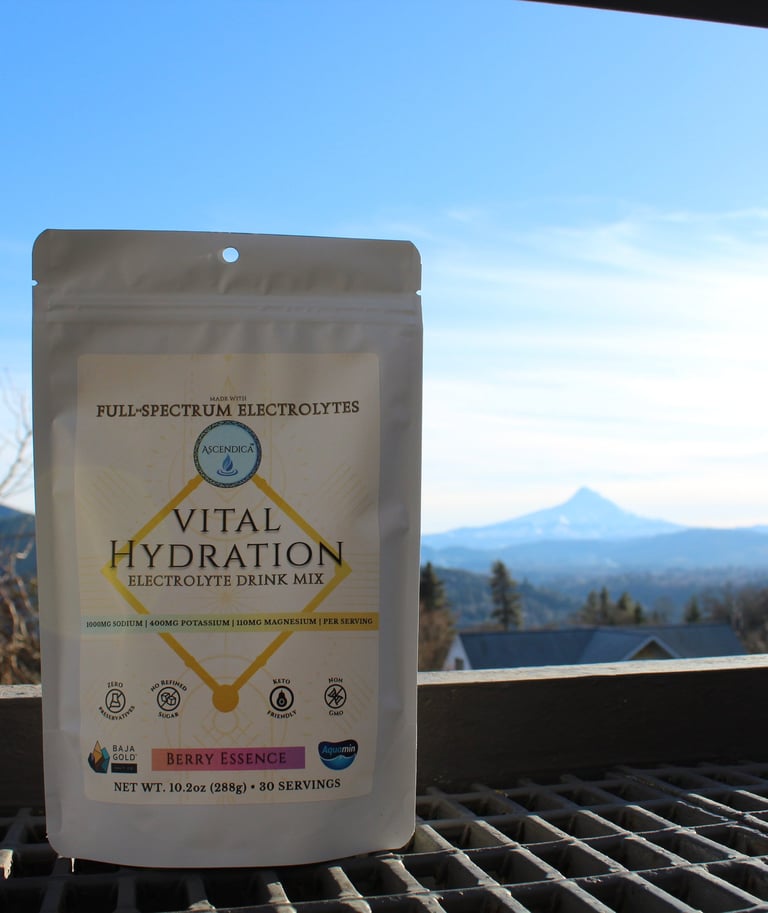
1,000mg Sodium | 400mg Potassium | 110mg Magnesium 150mg Calcium Per Serving
Ascendica Vital Hydration
1 . Council for Responsible Nutrition (2025). "Magnesium." Vitamin and Mineral Safety, 4th Edition.
2. Godek, S. F., et al. Journal of Athletic Training (2010). "Sweat Rates, Sweat Sodium Concentrations, and Sodium Losses in 3 Groups of Professional Football Players."
3. Holmes, N., et al. Annals of Sports Medicine and Research (2016). "The Effect of Exercise Intensity on Sweat Rate and Sweat Sodium and Potassium Losses in Trained Endurance Athletes."
4. Valentine, V. Current Sports Medicine Reports (2008). "Sodium Balance and Exercise."
5. Aslam, M. N., et al. (2021). "A Multi-Mineral Intervention to Modulate Colonic Mucosal Protein Profile: Results from a 90-Day Trial in Human Subjects."
6. Felice, V. D., O'Gorman, D. M., O'Brien, N. M., & Hyland, N. P. (2018). "Bioaccessibility and Bioavailability of a Marine-Derived Multimineral, Aquamin-Magnesium."
7. Dowley, A., et al. (2024). "The bioaccessibility and tolerability of marine-derived sources of magnesium and calcium."
8. Crowley, E. K., et al. (2018). "Dietary Supplementation with a Magnesium-Rich Marine Mineral Blend Enhances the Diversity of Gastrointestinal Microbiota."
9. Yu, Z., Li, Y., Ba, D. M., Veldheer, S. J., Sun, L., Geng, T., & Gao, X. (2024). "Trends in Calcium Intake among the US Population: Results from the NHANES (1999–2018)
10. Reid, I. R., Bristow, S. M., & Bolland, M. J. (2017). "Calcium and Cardiovascular Disease." Endocrinology and Metabolism
11. Aslam, M. N., et al. (2010). "A Mineral-Rich Extract from the Red Marine Algae Lithothamnion calcareum Preserves Bone Structure and Function in Female Mice on a Western-Style Diet."
12. Zenk, J. L., Frestedt, J. L., & Kuskowski, M. A. (2018). "Effect of Calcium Derived from Lithothamnion sp. on Markers of Calcium Metabolism in Premenopausal Women."
13. Bashir, O., et al. (2023). "Influence of Anticaking Agents and Storage Conditions on Quality Characteristics of Spray Dried Apricot Powder.
14. Lipasek, R. A., Taylor, L. S., & Mauer, L. J. (2011). "Effects of Anticaking Agents and Relative Humidity on the Physical and Chemical Stability of Powdered Vitamin C
References
Connect
Stay updated with Ascendica
Customer care
Subscribe to our newsletter
info@drinkascendica.com
(206) 801-5232
© 2025 Ascendica LLC. All rights reserved.
*These statement have not been evaluated by the Food and Drug Administration. This product is not intended to diagnose, treat, cure, or prevent any disease.
Quick Links